In hot water and loving it
New Zealand’s Polynesian Spa is an internationally renowned thermal resort that has become one of the region’s most successful businesses. Alfa Laval has played a significant part in this.
DATE 2026-01-12 AUTHOR Annette TaylorAfter successfully completing a multimillion-dollar redevelopment of Polynesian Spa in Rotorua, New Zealand, Managing Director Martin Lobb says he’s looking forward to the day-to-day running of the family business.
“As with any company, there are various projects to be involved in,” he says. “Innovating and building is nice, but then it’s equally nice to settle down to run what you’ve created, to make sure it works and is promoted well. I’m looking forward to that this year.”
Polynesian Spa’s complex network of mineral pools
Nestled on the shores of Lake Rotorua, Polynesian Spa is New Zealand’s leading international spa. It has provided thermal bathing to millions of visitors since it opened more than 125 years ago. Today it offers 26 hot mineral pools filled with water from two natural springs. The complex also features a large freshwater family pool, the Hot Springs café and the Spa Essentials gift shop. Also within the complex is the Lake Spa Retreat, offering a range of hydro and dry relaxation spa therapies that make use of Rotorua thermal mud, New Zealand Manuka honey and other natural ingredients to relax and soothe bathers.
Voted one of the world’s top 10 spas by the Conde Nast Traveller magazine from 2004 to 2007, Polynesian Spa attracts more international visitors than any other spa in New Zealand; about 60 percent of its customers come from overseas.
Four years ago the spa management decided to create capacity in the form of 13 new private rock pools and three terraced adult pools. “The private pools were 30 years old, and you get to a stage where you can’t continue to repair them,” Lobb says. “Also we needed extra capacity in the public bathing pools, especially at peak times.”
30 years and more...
Alfa Laval was an important part of the process. The spa uses the company’s plate heat exchangers to transfer the heat from the geothermal bore to the various pools in the complex.
Geothermal bores have long been used in Rotorua for heating domestic water, space heating and swimming pools. Such was the extent of past draw-off that by the 1980s it was apparent the city’s world-famous geysers and other thermal attractions were suffering, and in 1986 strict controls on such bores were implemented.
The geothermal fields have now recovered, but restrictions on bores remain in place. Businesses such as Polynesian Spa are permitted to draw only a limited amount each year and must make optimal use of the resource allocated to them.
“Like all business these days, you have to think about sustainability, the environment and the best use of a limited resource,” says Lobb. “Alfa Laval was able to help us achieve a solution because their technology is so efficient. What it came down to was, if we wanted more pools, we had to think of smarter ways of doing it.”
Polynesian Spa has used Alfa Laval technology for about 30 years, Lobb says. “In the past we’ve used their heat exchangers for heating buildings and domestic water, but in this latest plan we use them also for heating pool water and sanitizing,” he says. “And along the way we’ve built a good working relationship with them. Because we’re not engineers, we have to work with the experts who can assist us.”
Lobb says he is delighted with the results of the NZD 4 million (USD 3 million) redevelopment, which also allows for future growth.
Always evolving: heat exchangers
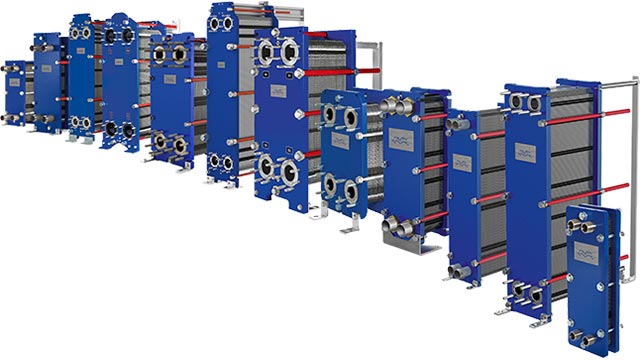
Plate heat exchangers, such as those used at Polynesian Spa, transfer heat efficiently from one fluid to another in a controlled fashion.
At the spa the primary heat source is superheated steam from a bore that taps into the geothermal field underlying Rotorua. The Alfa Laval plate heat exchangers transfer heat from this to a freshwater loop, which then transports the heat to another set of heat exchangers. These supply both fresh and mineral waters of varying temperatures to the various pools of the complex, which are each kept at a specific temperature, mostly ranging from 36 to 42 degrees Celsius, with a large chlorinated freshwater family spa pool at 33 degrees Celsius. The geothermal source is also employed, via the heat exchangers, to provide underfloor heating, domestic hot water and space heating.
Alfa Laval quality coordinator Marian Ioan says Alfa Laval is at the forefront of heat exchange technology. “We’ve pushed hard with new ideas,” he says. “Plate heat exchangers are flexible technology and are always evolving, with new plate and gasket designs almost every year. If increased capacity is required, it’s easy to add more plates.”
Because of the restrictions on use of the geothermal resource, it is essential to capture as much of the available free heat as possible, Marian says. “The plate heat exchangers can offer heat transfer coefficients that are four and a half times higher than those of a shell and tube exchanger,” he says.
The company provides most of the heat exchangers for Rotorua’s motels, but Polynesian Spa is its biggest customer in the city, with 16 units on site. Martin Lobb, the spa’s managing director, says the plant design allows the spa to reheat, filter and sanitize the thermal pool water, thus reducing the use of a scarce resource. “Our waste pool water has all the contaminants removed before it is discharged to Lake Rotorua under a discharge permit,” he says.